If you are dreaming about more land, more privacy, and a home that feels tucked into nature, Portola Valley may be on your list for good reason. But buying a home on acreage here is not just about finding the biggest parcel on paper. You need to understand how the land actually works, what can be built, and what long-term ownership may require. Let’s dive in.
Why acreage in Portola Valley stands apart
Portola Valley is shaped by estate-style residential districts that include 1-acre, 2-acre, 2.5-acre, and 3.5-acre categories, with slope-density combining districts applied across much of the town. According to the Portola Valley General Plan, these rules are meant to preserve the natural environment, protect drainage, support safe development, and maintain the town’s rural character.
That matters when you shop for property here. In many markets, acreage is mostly a number. In Portola Valley, acreage is also a planning question, a topography question, and often a usability question.
Look beyond gross lot size
One of the biggest surprises for buyers is that gross acreage is not the same as usable acreage. The town’s planning framework explains that private-road area is subtracted from lot size, and "net acre" can exclude easements, seismic setbacks, riparian setbacks, sensitive habitat areas, and similar constraints.
In practical terms, that means a 2-acre parcel may not offer 2 acres of flexible use. The true building envelope can be much smaller than what appears on a tax record or listing sheet, so it is important to evaluate the land itself, not just the headline number.
Slope affects buildability
Topography is a major factor in Portola Valley. The General Plan notes that most remaining vacant land is steep, with about 70% of the Upper and Lower Western Hillsides above 30% slope and 25% above 50% slope. You can review that context in the town’s planning materials.
That is why buyers often focus less on parcel size and more on flatter, more usable terrain. Slope-density rules are designed to direct development toward suitable portions of a site, which can shape everything from where an addition may go to how outdoor space functions day to day.
What lifestyle acreage can offer
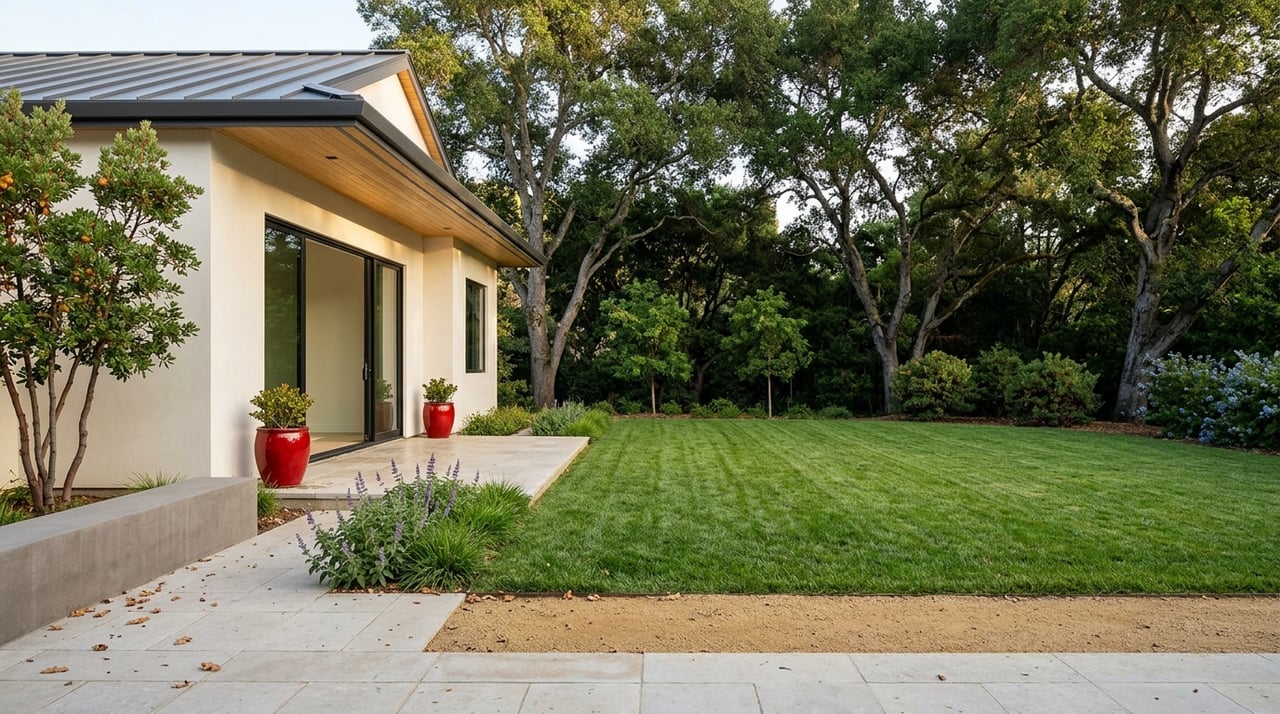
For many buyers, the appeal of Portola Valley acreage is simple: more separation, more privacy, and a stronger connection to the landscape. The town’s design guidance encourages homes and structures to fit their natural setting, with colors, materials, and landscape plans that support privacy, shade, erosion control, and a lower visual impact.
This approach helps explain why many properties feel more integrated with their surroundings than in a typical subdivision. The landscape character is intentionally informal and natural rather than highly formal or heavily built out.
A rural feel with open space nearby
Portola Valley’s General Plan describes more than 1,000 acres of public open space within town limits. That helps create the trail-oriented, rural atmosphere many buyers are seeking when they start exploring larger parcels here.
The same planning guidance favors native and California-native plantings, clustered planting, and broader areas of grasses or indigenous plants. If you are drawn to a property because it feels serene and understated, that character is not accidental. It is reinforced by local land-use and landscape policies.
ADU potential depends on the parcel
A larger parcel can sometimes offer more flexibility for future living space, but the details matter. Portola Valley’s ADU and JADU overview states that parcels over 3.5 acres can allow a detached ADU, an internal ADU, and a JADU, while smaller parcels are generally limited to one ADU plus one JADU.
Even then, what is theoretically allowed is not always what is practically feasible. Sewer or septic capacity, fire access, and geologic constraints still affect what can actually be approved and built.
Ask early about future plans
If you are hoping for guest space, a home office, housing for extended family, or another accessory structure, it is smart to investigate those goals before you write an offer. On acreage property, long-term value often depends on whether the site can support the way you want to live, not just whether you like the existing house.
Fire readiness is part of ownership
Wildfire preparation is one of the most important ownership realities for acreage properties in Portola Valley. CAL FIRE notes that fire-hazard maps show hazard rather than risk, and local compliance obligations still matter at the property level.
The Woodside Fire Protection District serves Portola Valley and connects wildfire preparedness to home hardening and defensible space. Its local fuel-mitigation ordinance requires defensible space around structures, and for a sale, compliance documentation from the Fire Code Official is required before closing.
Access can affect safety and convenience
On larger parcels, the driveway deserves as much attention as the house. Under the Woodside Fire Protection District’s fire code amendments, fire apparatus access roads must be at least 20 feet wide, and driveways serving a single property with habitable dwellings must have at least 12 feet of unobstructed width and 13 feet 6 inches of vertical clearance.
Private bridges and elevated access structures may also need engineer review and posted load limits. Gates, turnarounds, and driveway geometry can influence both daily ease of use and emergency response, so they should be part of your due diligence.
Check water, sewer, septic, and wells
Site infrastructure can vary from one property to the next. Cal Water’s Bear Gulch District serves Portola Valley and nearby communities, but buyers still need to confirm whether a specific home is on public water, a well, public sewer, or an onsite wastewater treatment system.
That distinction matters because maintenance, permitting, and upgrade costs can differ significantly. San Mateo County notes that parcels served by an OWTS or septic system and-or an individual domestic water supply well are evaluated by Environmental Health Services during permitting, and a well construction permit is required for a new well.
Plan for permits and site work
With acreage, improvements often extend beyond the house. A pool, retaining wall, reworked driveway, new landscape plan, drainage solution, or major tree work may all involve more review than buyers expect.
San Mateo County’s Drainage Manual applies to new and redevelopment work in unincorporated areas and may require drainage review, including civil engineering on more complex projects. Portola Valley’s permit FAQ also notes that larger additions, grading, vegetation removal, and significant tree work can trigger site-development review.
Budget for time, not just cost
For acreage buyers, the lesson is straightforward. If you plan to make meaningful changes, budget for permitting timelines as well as construction costs.
A property may still be an excellent fit, but you will want clear eyes about what future work could involve. In a town where development is intentionally shaped by terrain, drainage, access, and environmental constraints, planning ahead can save a great deal of frustration.
Questions to ask before you make an offer
Before you move forward on a Portola Valley acreage property, try to answer these questions as early as possible:
- How much of the parcel is truly usable after roads, easements, slope, and setback constraints are removed?
- Is the property on public water and sewer, or does it rely on a well and-or septic system?
- What fire-hazard zone applies to the address, and what defensible-space obligations follow?
- Do the driveway, gate, bridge, and turnaround appear to meet local fire-access expectations?
- Will your future plans for remodeling, adding space, grading, landscaping, or tree work require town or county review?
These are not minor details. On acreage, they often shape both your ownership experience and the property’s long-term flexibility.
A smarter way to evaluate Portola Valley land
When you compare Portola Valley with other rural Peninsula communities, the best question is not simply, “How big is the lot?” A better question is, “How much of this land is usable, maintainable, and aligned with the way I want to live?”
That is where careful guidance can make a real difference. If you are considering a home on acreage in Portola Valley, Hummingbird Homes can help you evaluate the practical tradeoffs behind the listing photos so you can move forward with more clarity and confidence.
FAQs
What does usable acreage mean for a home in Portola Valley?
- Usable acreage refers to the portion of a parcel that remains after accounting for factors like private roads, easements, setbacks, slope, and sensitive areas that can limit where you can build or make improvements.
How do slope rules affect buying acreage in Portola Valley?
- Slope can reduce where development is feasible, and Portola Valley’s planning rules are designed to direct building toward flatter parts of a site rather than treating all land on a parcel as equally buildable.
Can a Portola Valley acreage property have an ADU?
- Possibly. Town guidance says smaller parcels are generally limited to one ADU plus one JADU, while parcels over 3.5 acres may allow a detached ADU, an internal ADU, and a JADU, subject to site constraints.
What fire access issues should buyers check on acreage in Portola Valley?
- Buyers should review driveway width, vertical clearance, gates, turnarounds, bridges, and other access features because local fire code standards can affect both safety compliance and future property use.
How can I tell if a Portola Valley property uses public utilities or private systems?
- You should confirm whether the home is served by public water and sewer or relies on a well and-or septic system, since that can affect maintenance, permitting, and future improvement plans.